
If you’ve built a real business , one with real revenue real complexity and a real team , you’ve probably wrestled with the EOS vs scaling up question: what operating system do we actually run on?
The two names that dominate this conversation are EOS (the Entrepreneurial Operating System) and Scaling Up, both built on Verne Harnish’s Rockefeller Habits framework. Both have helped thousands of companies grow. And both carry real limitations that most consultants won’t surface until you’ve already committed.
This guide gives you an honest practical comparison of EOS vs Scaling Up , what each business operating system actually does, where each one breaks down and what comes next for businesses that have outgrown both.
EOS , the Entrepreneurial Operating System , is a business operating system built to help entrepreneurial companies execute with discipline. Built by Gino Wickman as a streamlined version of Verne Harnish’s original framework, the EOS Entrepreneurial Operating System gives founder-led businesses a practical toolkit: a clear accountability chart, a method for setting and hitting quarterly priorities (Rocks), and a meeting structure centered on the Level 10 format.
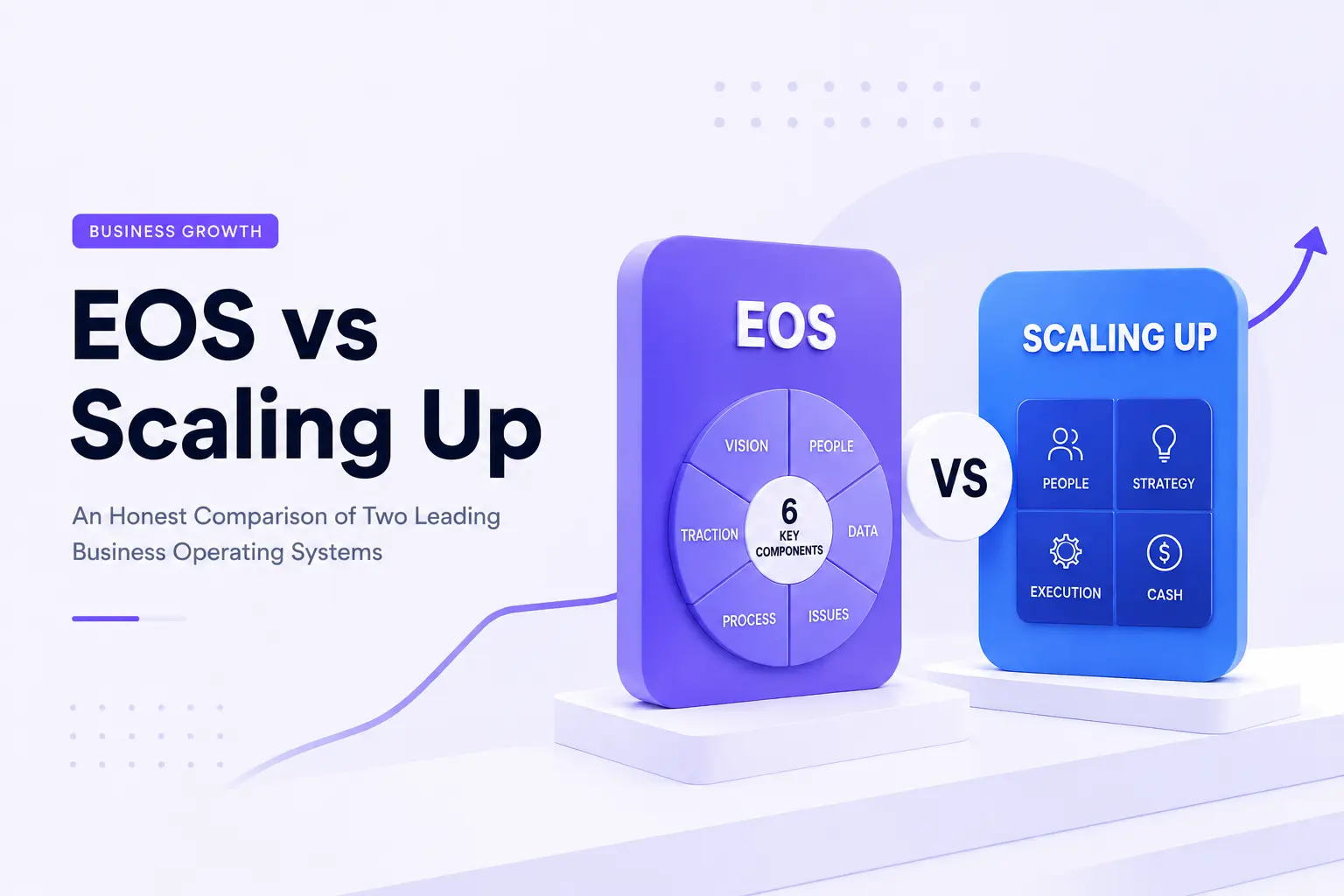
The six key components of EOS , Vision People Data Issues Process and Traction , give teams a shared language and rhythm. EOS creates alignment quickly. The meeting structure alone eliminates the organizational fog that often kills early stage businesses.
EOS promises operational clarity and a straightforward path to alignment. For the right company’s stage it delivers.
Scaling Up is Verne Harnish’s refinement and expansion of his original Rockefeller Habits business operating system — derived from the management practices of the great industrialist John D. Rockefeller. The Scaling Up framework runs on making the right decisions in four key areas: People, Strategy, Execution, and Cash.
Scaling Up’s position is that most businesses plateau because their strategy is weak, they don’t have the right people accountable for the right things, their cash flow management is reactive, and their execution lacks focus and consistency. Scaling Up offers tools and a systematic approach for getting all four of these areas under control so the firm can fire on all four cylinders.
Scaling Up’s tools include a strategic planning tool that captures the company’s purpose, long-term targets, annual priorities, and quarterly focus — as well as the Rockefeller Habits Checklist, which helps keep the entire organization moving in sync around critical numbers.
Scaling Up’s approach to cash management is one of its most important differentiators. Scaling Up’s curriculum includes cash acceleration strategies and a disciplined focus on cash flow that most business operating systems ignore entirely. Scaling Up’s framework treats strategy, people, cash, and execution as one integrated system — equally critical components, not separate conversations.
Scaling Up emphasizes leadership development as a core discipline. Scaling Up’s framework is designed for companies with the leadership depth and operational foundations to compete at a higher strategic level.
The EOS vs Scaling Up debate isn’t about which operating system is better. It’s about which is right for where you are. Here’s an honest breakdown.
This is the sharpest key difference between the two frameworks. EOS does deliver strategic clarity — everyone knows the direction. But the comparison between Scaling Up vs EOS on strategy isn’t close: Scaling Up goes far deeper.
Scaling Up’s one-page strategic plan core customer definition and brand promise framework give companies tools that EOS doesn’t offer. Scaling Up vs EOS here reflects a fundamental design choice: EOS creates alignment around a destination; Scaling Up’s approach builds the strategy for getting there and beyond.
EOS wins on accessibility for smaller firms. EOS and Scaling Up both use structured meeting rhythms but EOS’s implementation approach is simpler to sustain. The Level 10 meeting and quarterly Rock-setting process are among the most practical execution habits in any business operating system. Most leadership teams can align teams around EOS’s execution layer quickly without heavy coaching support.
Scaling Up’s full execution mechanics are more powerful but can be harder to sustain. Scaling Up’s approach covers critical numbers tracking and real-time problem-solving disciplines, but implementing Scaling Up’s full execution layer requires organizational capacity that many small businesses haven’t yet developed.
Scaling Up wins clearly. Cash flow is central to Scaling Up’s framework in a way that it simply isn’t to EOS. Scaling Up’s philosophy teaches teams to understand which levers move cash. For companies where cash management is a constraint on scaling EOS and Scaling Up’s differences on this dimension are significant.
Scaling Up is explicitly designed as a performance platform for scaling-stage companies , built to scale businesses into high-value exits. EOS functions as an alignment-stage operating system optimized for different objectives.
EOS has a ceiling. At the right company’s stage , $1M to $10M , EOS creates team alignment and execution discipline fast. But as businesses push past $15M the limitations become visible. The function accountability chart is clean. Key results are consistent. EOS and Scaling Up’s advocates rarely admit what happens in between.
EOS doesn’t have sophisticated tools for market expansion strategy or for building the organizational infrastructure the entire organization needs to compete at enterprise scale. Companies running EOS above $15M typically describe the same experience: the business is well-run revenue has gone flat and the operating system doesn’t have an answer for what comes next.
Scaling Up has a steep entry barrier. Scaling Up’s depth on strategy execution and cash is its strength and its challenge simultaneously. Most leadership teams that try to implement Scaling Up’s full framework without a solid operational foundation , clear meeting rhythms entire team aligned around process real time problem solving already embedded , struggle to make it stick.
Scaling Up’s framework requires strategic clarity and execution discipline at the same time. If EOS hasn’t already created team alignment, a proper Scaling Up implementation would require setting these foundations in place first — otherwise, Scaling Up’s strategic layer sits on top of organizational chaos and produces very little.
The honest conclusion: there is a stage between operational clarity and genuine scale that neither EOS nor Scaling Up was designed to solve. It’s the stage where business growth has plateaued despite strong execution execution is strong and expansion still feels impossible to engineer.
EOS is well suited for:
Founder-led entrepreneurial companies between $1M and $10M that need to create alignment and accountability quickly , smaller businesses that have never run a formal business operating system and leadership teams that want simple tools with a fast implementation approach.
Scaling Up is well suited for:
Companies between $5M and $100M with operational foundations already in place. Teams ready to go deep on strategy and cash flow management. Businesses pursuing aggressive growth through new markets products or geographies. Organizations ready to absorb Scaling Up’s full strategic framework.
Most companies that outgrow EOS find themselves in the same frustrating position. They’ve succeeded at EOS, meeting rhythms run, rocks get hit — and revenue has still stalled. Business growth has plateaued even though execution is strong and the business model is functioning.
These companies don’t need more operational discipline. They need a leadership development scaling strategy that builds the team’s capacity to grow without the founder a revenue engine beyond founder-driven sales and a strategic planning capability built for real market expansion.
That’s exactly what Growth Beyond Traction was designed for.
Growth Beyond Traction is 1×1 Coaching’s growth framework for companies between $3M and $50M that have built their foundation on EOS and are ready for what comes next. It’s not a replacement for EOS , it’s a system that builds on EOS and Scaling Up’s best insights and delivers them in a way that’s designed specifically for the post-EOS stage.
Phase 1 , Operational Control
This is what EOS already gave you. Alignment. Accountability. Strong meeting rhythms. We build on it.
Phase 2 , Scalable Growth
This is the core work. Leadership development that creates an entire team capable of scaling without the founder. A revenue system that goes beyond owner-dependent sales. Market expansion strategy that engineers entry into new markets and verticals.
This phase builds the tier of leaders who can drive the business forward without founder dependence. It’s the gap EOS and Scaling Up leave open.
Phase 3, Enterprise Value
Valuation optimization. Exit readiness. Long-term value creation through M&A partnerships and new verticals. A business that a buyer pays a premium to acquire.
This framework is designed for companies in professional services and adjacent industries that are actively running EOS have a proven track record of operational execution and are thinking about an exit in the next three to seven years.
Some companies try a hybrid approach, running EOS for execution while layering in Scaling Up’s strategic planning tools. This hybrid system can work; borrowing Scaling Up’s critical numbers tracking within an EOS foundation is one example. The challenge: most hybrid system attempts underdeliver on both frameworks. Key elements get dropped when implementation gets complex. Choose specific components deliberately and hold the team to consistent execution.
Under $5M: Start with EOS. No other business operating system creates team alignment and execution discipline faster at this stage.
$5M–$15M with solid operations: Evaluate Scaling Up vs EOS carefully. Scaling Up’s strategic planning depth and performance platform are genuine. But the operational foundation needs to be stable before Scaling Up’s full framework pays off.
$5M–$50M post-EOS revenue stalled: You’ve outgrown the system not failed it. The operating system that built your foundation isn’t the one that takes you to exit.
That last group is who we work with.
Take the free Growth Assessment →
Get your Practice Growth Score and find out exactly what’s capping your next stage. Or book a Growth Strategy Call with our team , no pitch just clarity.
Book Your Growth Strategy Call →
1×1 Coaching works with companies between $3M and $50M that have built their business on EOS and are ready for what comes next. Our Growth Beyond Traction growth framework is the bridge between operational excellence and scalable enterprise value.
Category :
Share :